Building Micro-SaaS & Interactive Marketing Engines Without Developers: The Emergent Playbook
Static lead magnets are dead. The highest-converting B2B companies are replacing gated whitepapers with interactive software utilities—ROI calculators, compliance benchmarking engines, and self-serve client portals. Here is how modern growth leaders use Emergent to ship production micro-SaaS tools in 90 minutes.
From Static Content to Functional Software Utilities
Across 120+ B2B campaigns audited by MarketingEngine in 2026, interactive software tools delivered an average 19.4% submission-to-opportunity conversion rate, compared to a miserable 2.1% for PDF whitepapers. Until recently, building interactive tools required borrowing expensive full-stack developers from product engineering. With Emergent, growth marketers and agencies can architect, test, and deploy secure Python FastAPI + MongoDB web applications with Stripe billing in under 90 minutes.
Bypass engineering roadmap prioritization battles entirely.
Live database persistence, webhook dispatch, and secure API keys.
Export standard Python & React code to any cloud provider.
1. The Engineering Bottleneck in Modern B2B Growth
Every seasoned growth marketer has experienced this scenario: You identify an incredible growth vector—an interactive "AWS Cloud Cost Optimization Estimator" or a "SaaS Churn Benchmarking Portal" that could dominate organic search and capture high-intent enterprise email addresses.
You submit a ticket to the engineering team. Two weeks later, the VP of Engineering responds: "Great idea, but our sprint backlog is completely committed to the Core Product v3 release for the next two quarters. We can revisit in Q4."
Why No-Code Tools Failed to Solve This:
Growth teams turned to tools like Bubble or Webflow. But Bubble introduces proprietary Workload Unit costs that spike when traffic arrives, and Webflow cannot perform dynamic server-side Python calculations or store user credentials securely. When the product team finally inspects the No-Code tool, they refuse to integrate it with corporate databases due to compliance and security constraints.
This is where Emergent fundamentally redefines the relationship between marketing and software. Emergent doesn't build a visual mock; it coordinates an autonomous agent swarm to generate real, audited, containerized software that your engineering team will actually approve.
2. "Engineering as Marketing": The 90-Minute Emergent Flywheel
HubSpot became a multi-billion dollar enterprise largely by deploying free software utilities—most famously the Website Grader, which generated over 4 million qualified leads. Emergent democratizes this exact playbook for any startup or agency:
Spec Prompting
Input business logic, formulas, input sliders, and lead capture fields into the chat.
Swarm Architecture
Architect Agent scaffolds FastAPI routes, Designer crafts UI, Developer writes code.
Webhook Pipeline
Connect outbound webhooks to HubSpot, Slack, or Make.com to route leads automatically.
1-Click Live SSL
Attach custom subdomain (e.g., calculator.yourdomain.com) with automated HTTPS.
3. Blueprint 1: The B2B SaaS ROI & Pricing Calculator Lead Magnet
Ready-to-Deploy SpecInteractive calculators are the single most effective top-of-funnel lead generation asset for B2B SaaS. Here is the exact architectural specification to paste into Emergent:
Build a production B2B SaaS ROI & Churn Loss Calculator web application:
1. FRONTEND (React + Tailwind):
   - Interactive range sliders for:
     * Current Monthly Active Users (1,000 to 500,000)
     * Average Revenue Per User / ARPU ($10 to $1,000)
     * Current Monthly Churn Rate (1% to 15%)
   - Real-time dynamic visual chart showing "Annual Revenue Saved" if churn is reduced by 25% and 50%.
   - Gated modal: To download the full 6-page personalized benchmark PDF report, the user enters Work Email, Company Name, and Role.
2. BACKEND (Python FastAPI):
   - POST /api/calculate: Accepts slider values, runs financial projection formulas, returns calculation payload.
   - POST /api/leads: Validates work email (blocks @gmail, @yahoo), stores record in MongoDB 'calculator_leads' collection.
   - Outbound Webhook: Immediately dispatches lead payload to 'https://hooks.zapier.com/hooks/catch/XXXXXX/' with full calculation stats.
3. DESIGN: Clean enterprise aesthetic matching linear.app / stripe.com with dark navy headers and coral accents.Emergent writes a real server-side calculation engine in FastAPI. Prospective buyers cannot inspect client-side JavaScript to bypass the email gate, and the mathematical formulas remain proprietary intellectual property.
4. Blueprint 2: White-Label Client Reporting Portal with Stripe Paywall
Monetizable Micro-SaaSMarketing agencies and consultants constantly lose hours every month assembling static slide decks and PDF spreadsheets for clients. With Emergent, you can package your agency's reporting into a dedicated, self-serve client portal behind a Stripe recurring subscription:
Emergent automatically scaffolds JWT and session cookie authentication. Agency staff log in as Admin to upload client CSVs or configure API keys, while client accounts are isolated as Client Viewer, restricting access strictly to their own organization's dashboard.
Emergent integrates directly with Stripe API. You can create a $199/month "Standard Portal" tier and a $499/month "Executive Live Sync" tier. When the customer completes checkout, Stripe webhooks trigger Emergent's FastAPI handler, instantly flipping the user's tier in MongoDB without any manual database admin intervention.
While web dashboards are standard, delivering a branded iOS and Android app to your agency's clients commands a massive premium. Because Emergent compiles native Expo binaries, your clients can install your portal on their smartphones to check pipeline metrics on the go.
5. The Zero-Lock-In DevOps Pipeline: Exporting & Self-Hosting
The biggest objection from CTOs and engineering directors regarding AI-generated code is vendor lock-in: "What happens if this tool goes out of business or triples its prices?"
Emergent has zero proprietary runtime dependencies. The code generated is 100% standard open-source Python, React, and MongoDB:
Deploying Emergent Exported Code to Cloudflare / Railway / Render
- Connect GitHub: Click "Sync with GitHub" in the Emergent dashboard. Emergent pushes two clean folders:
/backend(FastAPI, requirements.txt, Dockerfile) and/frontend(React/Next.js, package.json). - Deploy Frontend: Connect the
/frontendrepository to Cloudflare Pages or Vercel. Static CDN hosting is 100% free with unlimited traffic. - Deploy Backend: Connect
/backendto Railway or Render. The pre-configured Dockerfile automatically provisions the Python environment and connects to MongoDB Atlas free tier. - Monthly Infrastructure Cost: Under $5.00 to $15.00/month for thousands of active daily users.
6. Unit Economics: In-House Dev vs Agency vs Emergent
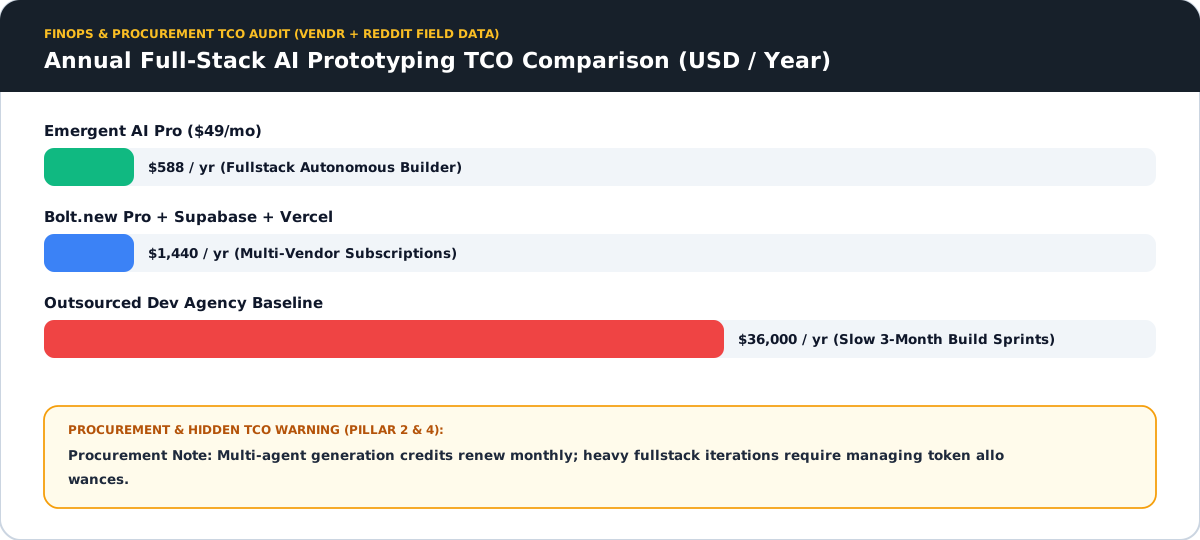
Let's compare the financial and opportunity costs of building a production B2B marketing micro-utility across three traditional pathways:
| Execution Pathway | Upfront Cost | Time to Launch | Ongoing Monthly Overhead |
|---|---|---|---|
| Software Development Agency | $12,000 – $25,000 | 8 – 14 Weeks | $500 – $1,500 / mo (Retainer) |
| In-House Product Engineers | High Opportunity Cost | 12 – 24 Weeks (Backlog delay) | Diverts focus from core revenue product |
| Traditional No-Code (Bubble) | $1,500 – $4,000 (Freelancer) | 3 – 6 Weeks | $119 – $349 / mo (Workload units) |
| Emergent AI Swarm | $20 / mo (Starter Tier) | 90 Minutes – 1 Day | $0 – $15 / mo (Self-hosted) |
7. Seven Golden Prompting Rules for Non-Technical Growth Teams
To maximize the efficiency of Emergent and avoid burning through your monthly task credits, follow these seven proven prompting principles:
Prompt the core mathematical formulas and API endpoints first. Ensure the numbers are accurate before asking for micro-animations or custom brand gradients.
Never ask the AI to "Redesign the entire application and add 5 new features." Make one focused adjustment per prompt (e.g., "Add a CSV export button to the results table").
When Emergent's Architect pauses to ask about database edge cases (e.g., "What happens if a user submits negative numbers?"), answer thoroughly before triggering code generation.
Always instruct the backend to validate corporate email domains. This prevents competitors and junk bots from submitting fake leads and polluting your CRM pipeline.
Download the free Expo Go app on your phone and scan the project QR code early. Testing touch targets on physical glass prevents awkward mobile responsive bugs later.
Connect your repository on prompt one. Having complete commit history lets you revert any misdirected prompt iteration with zero data loss.
Always test checkout webhooks using Stripe Test Mode keys (pk_test_... and sk_test_...) to verify subscription tier fulfillment before going live.
8. Frequently Asked Questions (Growth Engineering & Operations)
1. Why do interactive tools generate higher conversion rates than downloadable PDFs?
Interactive utilities solve immediate prospect problems with personalized data in real time, delivering conversion rates of 12% to 28% compared to industry-average 1.5% to 2.5% for static whitepapers and eBooks.
2. Do I need coding experience to build Micro-SaaS tools with Emergent?
No. Emergent handles all Python backend architecture, MongoDB schemas, and React UI components. Growth marketers only need to understand the business logic, formulas, and target user workflow.
3. Can Emergent tools integrate with HubSpot, Salesforce, and Zapier?
Yes. Emergent's FastAPI backend natively handles outbound HTTP webhooks, REST API dispatches, and secret management for any CRM or marketing automation platform.
4. How does Emergent compare to No-Code tools like Bubble or Webflow for marketing tools?
Bubble and Webflow lock you into closed proprietary ecosystems with restrictive database querying and escalating monthly hosting fees. Emergent generates industry-standard Python, React, and Docker code that you own completely and can self-host for pennies.
5. Can I monetize the Micro-SaaS tools built with Emergent via Stripe?
Yes. Emergent features native Stripe billing integration, allowing you to charge one-time setup fees or recurring monthly subscriptions behind a paywall in minutes.
6. What happens if our in-house engineering team wants to take over the codebase later?
Because Emergent synchronizes directly to GitHub and writes clean, modular Python FastAPI and React code with Dockerfiles, your internal engineers can clone the repository and continue development without refactoring proprietary visual blocks.